

Home-cage monitoring
A new era in safety pharmacology: continuous, automated home-cage monitoring delivers earlier warning of CNS effects and better animal welfare.
ACTUAL ANALYTICS is proud to announce the publication of a landmark multi-company validation demonstrating that automated home-cage monitoring (HCA) can uncover clinically relevant CNS-related behavioural effects that traditional episodic assessments (Irwin/FOB) fail to detect.
The paper, “Rodent home cage monitoring for preclinical safety pharmacology assessment: results of a multi-company validation evaluating nonclinical and clinical data from three compounds,” is the result of collaboration between scientists from Actual Analytics, AstraZeneca, GlaxoSmithKline, Janssen, Charles River Laboratories, ICON, the University of Edinburgh, and the UK’s National Centre for the Replacement, Refinement and Reduction of Animals in Research (NC3Rs).
Bridging the Gap Between Preclinical and Clinical Findings
Central nervous system (CNS) safety issues remain a leading cause of late-stage attrition in drug development, costing the industry billions per annum. Traditional behavioural safety tests such as the Functional Observational Battery (FOB) and Irwin tests rely on brief, observer-based assessments conducted under artificial conditions — leaving long periods when animals are unobserved, especially during the dark phase when they are most active.
This research validates the ActualHCA™ system for use in preclinical safety pharmacology and repeat-dose toxicology studies. It represents one of the most comprehensive evaluations to date of automated behavioural monitoring under real-world study conditions.
The study demonstrates that ActualHCA™ provides a powerful alternative, enabling continuous, non-invasive behavioural and physiological monitoring of socially housed rodents. This approach allows researchers to detect subtle and long-lasting CNS effects that might otherwise go unnoticed in conventional testing.
A Multi-Company Validation Study
In this large-scale collaborative validation, three historical compounds were re-tested using the ActualHCA™ system. Each had previously passed standard preclinical safety pharmacology assessments but later showed central nervous system side effects during clinical or late-stage preclinical evaluation.
By continuously tracking locomotion, rearing, body temperature, social interaction, and drinking behaviour, the team uncovered clear behavioural changes with all three compounds that were not detected using traditional Irwin/FOB methods. Importantly, several of these effects persisted over multiple days and during the dark phase, highlighting the increased sensitivity and temporal depth of the home-cage approach.
“When you watch animals continuously in their normal social environment, you see what snapshots miss... These data show that decision-relevant CNS signals often sit in the dark phase or unfold over days—precisely where Irwin/FOB is blind.”
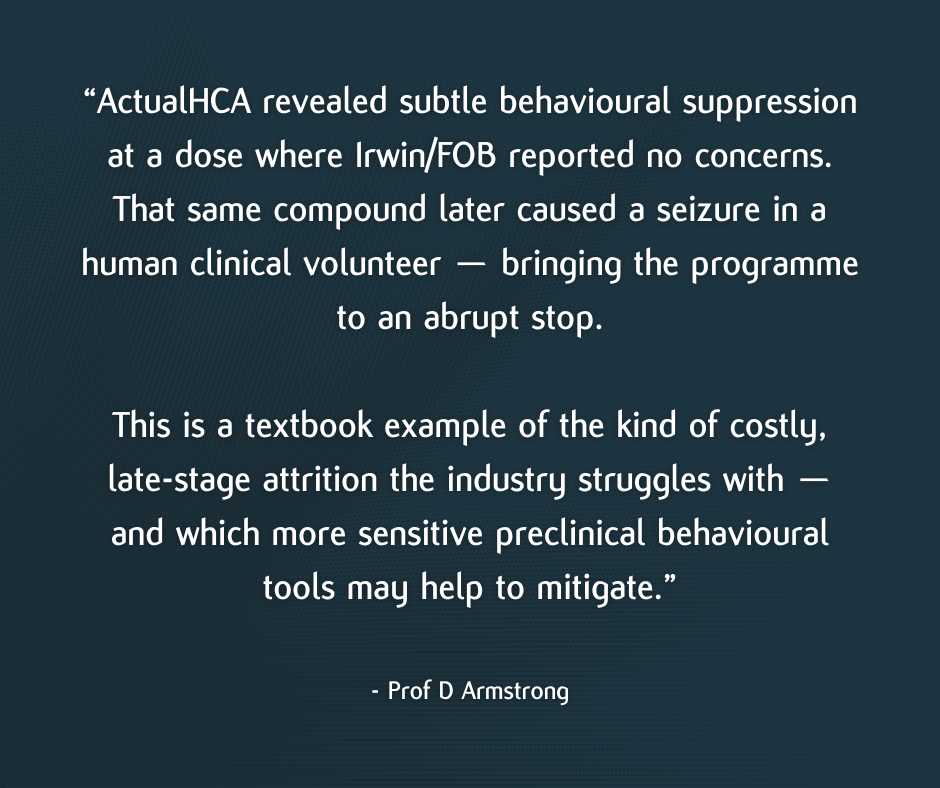
In one case, behavioural effects were evident at a dose previously reported as ‘well tolerated’ in standard assessments — the same compound later produced a seizure in a human subject during clinical testing. The results underscore HCA’s greater sensitivity at clinically relevant doses and its potential to strengthen translational confidence earlier in development.
Implications for Drug Development and Animal Welfare
Better detection: 24/7, objective readouts reveal dark-phase and longitudinal effects that episodic tests miss.
Operational fit: Demonstrated compatibility with repeat-dose toxicology workflows and minimal disruption to existing SOPs.
3Rs impact: Social housing, less handling, richer data per animal—supporting refinement and potential reduction.
Regulatory relevance: A practical path to complement—or with appropriate validation, replace—Irwin/FOB in GLP contexts.
Toward Regulatory Acceptance and Industry Adoption
The authors outline how home-cage monitoring could complement or ultimately replace current neurofunctional assessments both in early discovery and within GLP toxicology studies. Its inclusion could provide a more objective, welfare-friendly, and data-rich assessment of CNS safety risks, aligning with ICH S7A guidelines and supporting a more modern, evidence-driven approach to preclinical evaluation.
Prof. Douglas Armstrong, Chief Scientific Officer at Actual Analytics and corresponding author, commented:
“This study demonstrates that home cage monitoring can reveal safety-relevant effects that standard tests may miss. By continuously observing animals in their normal environment, we gain a much clearer picture of a compound’s impact—and can make better, earlier decisions in the development pipeline.”
Also from our collaborators
The NC3Rs, a key partner and co-author of the study, has published their own release highlighting the 3Rs and animal-welfare implications of this work.
About Actual Analytics
Actual Analytics Ltd is a leader in automated behavioural monitoring and data analytics solutions for preclinical research. Our ActualHCA™ system provides continuous, non-invasive behavioural analysis of rodents in their home environment, enabling high-quality insights that enhance translational validity while advancing animal welfare.
Our Distributors


Comments